Wilhelm ends digitization. By 2030.
The operating system for people and companies. Open. Sovereign. European.

The operating system for people and companies. Open. Sovereign. European.
Two directions. One operating system.
Digitization never ends because every application reinvents the same foundations: identity, data, processes, contracts, permissions, accessibility, privacy. Wilhelm standardizes those recurring building blocks once — as open infrastructure. From two directions at the same time.
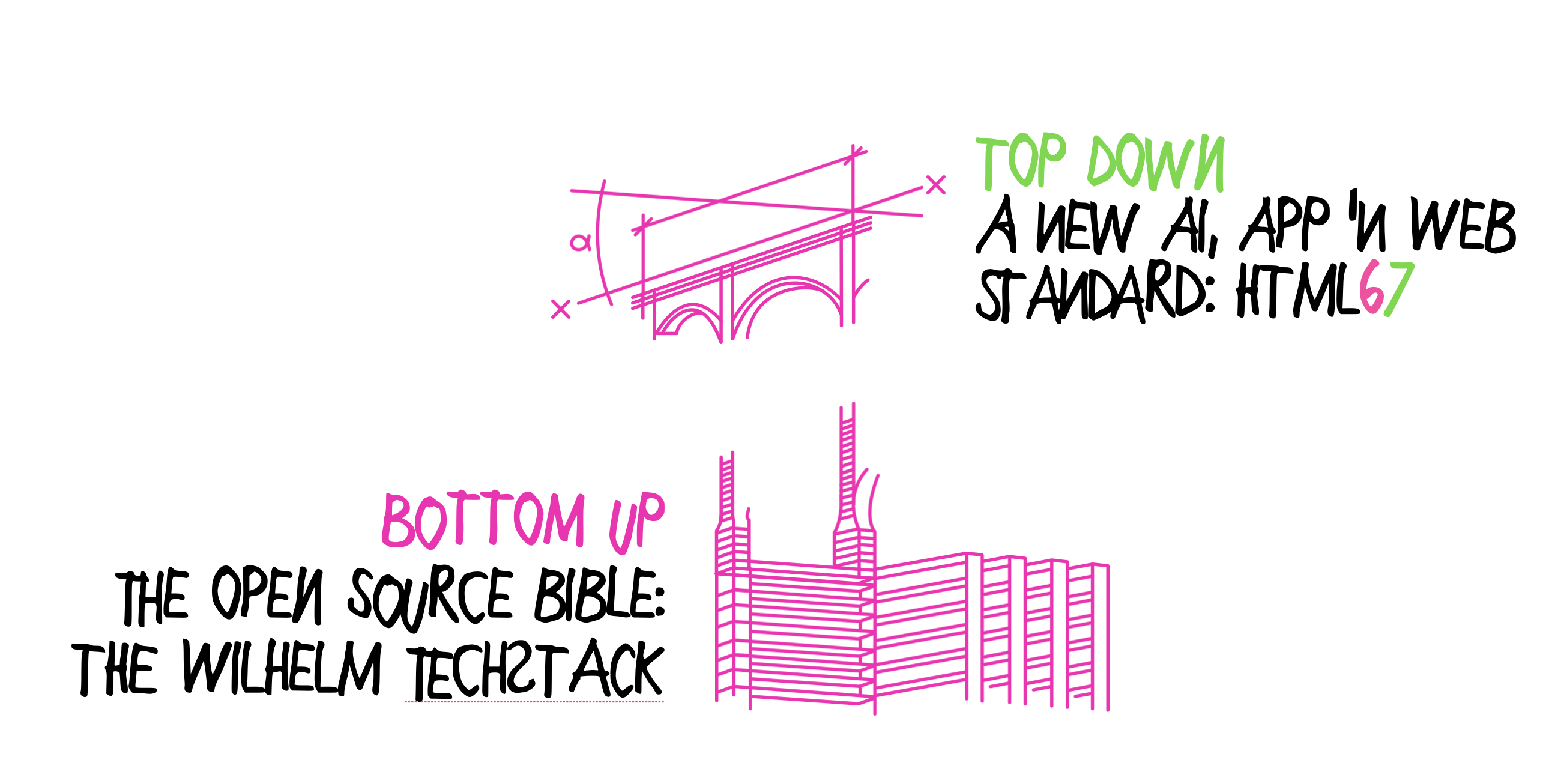
The Wilhelm Techstack is a bible of the strongest open-source packages. History keeps producing many books that describe the same thing — at some point, you bind them into one canon. However different today's languages and frameworks are, they all describe the same constants: users, data, processes, rights. We don't rebuild that software. We don't compete with it. We connect it — through a shared standard and an orchestration layer — into an operating system.
HTML gave the web one language for documents. HTML67 extends that principle to applications and institutions. HTML6 brings native UI components back into declarative markup — zero build step. HTML7 lifts institutional semantics into the standard itself: contract, consent, identity, ownership, proof. The principle behind it: law is not fundamentally textual. Law is institutional semantics.
Both directions meet in one shared semantic operating layer. AI composes verified applications from it instead of generating ever more code. The result: software as infrastructure — like water. Like power. Open, sovereign, European.
Everything is technically possible. Meaning is missing.
Computer science already solved computation. We simulate three-dimensional worlds in real time. So this is not a technical digitization problem. What's missing are semantic ontologies: a shared, machine-readable description of what our systems mean. That puts the task closer to language and law than to classical computer science — code alone can't solve it.
The gap shows up as four symptoms.
Thousands of excellent open-source projects exist — yet organizations can barely use them. Integration, authentication, updates, maintenance: all missing. Today, only the proprietary ecosystems of Microsoft, Google, and Apple fill that role. The price is vendor lock-in — with European value creation flowing abroad.
Programming languages know no institutional concepts. Contract, consent, ownership, permission — every application models them again, from scratch, as its own data model. Digital systems are technically powerful yet institutionally blind. That is exactly why government digitization is so slow, so expensive.
Accessibility (EN 301 549, WCAG), privacy (GDPR), information security (ISO/IEC 27001), UI ergonomics (ISO 9241) — the same requirements apply to virtually every piece of software. Yet every company, every agency implements, tests, and certifies them individually. An enormous economic cost for something that could be solved once, centrally.
As a living standard for hypertext, HTML is fine. In reality it carries far more responsibility: it is the only constant across all our systems. Whatever language a backend is written in, HTML connects them all. Whatever the standard can't express gets patched with framework sprawl and proprietary design systems — and the universal, interoperable web gets lost.
Wilhelm's goal: an open orchestration layer for the technical foundation, plus a formal semantic specification — HTML67 — for the institutional layer above it. By 2030, a new application is just its own data model, processes, and interface. Everything else, compliance included, is reused.
Three pillars. One vocabulary: HTML67.
Three pillars. An orchestration layer on top. And one semantic layer running through it all: HTML67.
The Kernel manages users, identities, files, permissions, authentication, and the shared interface. One identity, one login, one file system for every package. The Process Backend describes business processes, automations, and API traffic declaratively — workflows ship as versioned artifacts, not custom code. The Data Layer provides structured data, relational models, and shared schemas — packages declare their data models, the layer provisions them automatically.
The Wilhelm Orchestration Layer binds the pillars together through a package and manifest standard — what POSIX did for Unix, what deb/apt did for Debian. A package declares its dependencies, data models, workflows, and interfaces in its manifest. The layer handles installation, configuration, updates, and lifecycle. Existing open-source systems run inside it as container packages: swappable, auditable, self-hosted.
HTML67 supplies the vocabulary. HTML6 delivers 120+ native UI elements as declarative markup with zero build step. The reference runtime, Wilhelm UI, is implemented as custom elements — it runs in every browser today, no forks required. HTML7 defines the institutional layer: machine-readable elements for contracts, signatures, consent, roles, and proof — a hybrid PDF/HTML standard for law, norms, and science.
In practice: build with Wilhelm UI elements, and the component itself meets WCAG and EN 301 549 — no retroactive audit. The same holds for privacy patterns, ISO 27001 logging, and ISO 9241 ergonomics. That part of the law lives directly in code and markup. And because it is defined once, centrally, it becomes systematically measurable and certifiable for the first time.
On top, an AI layer translates requirements into compositions of packages and components. It selects, configures, and connects — instead of generating new code.
A standard can't be copied. Only adopted.
Four things set Wilhelm apart from every comparable approach.
Comparable projects work one-sided. Nextcloud or openDesk bundle software without a semantic standard. W3C or Schema.org standardize semantics without a runtime. Legal-tech efforts like Catala or the Accord Project formalize law without touching the web standard. Wilhelm is the only approach where real applications and institutional meaning meet in the middle.
Wilhelm treats law not as text for software to interpret after the fact, but as its own technical abstraction layer. Civil law, applied in code. That is a change of category — not an optimization.
Accessibility, privacy, security, and UI ergonomics are implemented once — centrally, in the standard and its components — instead of in every project. Conformance becomes a property of the platform, and quantifiable, because every application stands on the same verified parts. No other stack on the market offers that.
The market bets on generated code — multiplying fragmentation, technical debt, and maintenance load. Wilhelm uses LLMs to select, configure, and compose verified building blocks. Our working hypothesis: semantic markup and defined ontologies cut token usage per implementation task substantially — up to 50 percent, to be validated.
The lead is durable. The ontology and component work began long before the current AI hype, production reference implementations exist, and Wilhelm is positioned as an open standard. A standard that reaches adoption can't be copied — only adopted.
In production for years. TRL 6–7.
Overall system: TRL 6–7 — demonstrated in real operating environments. Not in a lab. With paying customers.
The technical foundation has run in production for years. Around ten agency projects were built on the recurring architecture patterns — those components reach TRL 8. Add production enterprise applications, including a digital industry platform that connects small operators, service companies, corporations, and inspection bodies — managing around 8,000 customers and technical assets. The architecture provably connects the roles of an entire market through shared data models. The hardest test for any interoperability claim.
The Wilhelm Techstack ships in a stable, published base version (TRL 7). HTML67 and Wilhelm UI exist as a working beta and MVP (TRL 5–6). The new elements aren't part of the official browser standard yet, so a JavaScript runtime interprets them — the intended path to standardization: custom elements first, then specification, then standards bodies. All of it bootstrapped: revenue from agency and client work, our own holding, private investment. Seven years of production groundwork.
The HTML67 editor was built in HTML67 itself. The system demonstrates its own applicability — the classic proof of maturity, like compiler bootstrapping. See it live: chat.html67.com.
Five phases. One standard.
From a stable core to a certified, self-sustaining ecosystem.
Stabilize the standard. Consolidate the package and manifest standard, unify the interfaces, harden the reference implementations, document the three pillars.
Specify HTML67. Define the institutional core components and shared ontologies. Cleanly separate semantics, representation, syntax, and medium. Write the formal specification and map it onto existing data and process systems.
Compliance, security, governance. External security audits, an ISO 27001-ready operating architecture, accessibility certification of the Wilhelm UI components against EN 301 549 / WCAG, review against ISO 9241, a GDPR pattern catalog, a license matrix, and a governance structure for the open standard. This one-time central certification work is what every later Wilhelm application inherits.
Developer platform. Standardized tooling, automated tests and validation, central documentation, contribution processes, community.
Reference projects. Complete applications for SMEs, public administration, and institutional processes — plus the controlled validation of the AI efficiency hypothesis: token usage, composition rate, error rate.
Success means: others build on it.
Wilhelm doesn't count its own applications. It counts whether the standard becomes the preferred foundation for everyone else. Five levels:
Active developers, external contributions, forks and installs, new Wilhelm packages, reuse rate, time to first running application.
Share of features shipped without custom infrastructure code, reduction of project-specific code, install and migration time, maintenance effort per application.
Because accessibility, privacy, and security are implemented centrally in the components, they become quantifiable across all applications for the first time: WCAG conformance of shipped interfaces, ISO 27001 control coverage through the platform, applications inheriting certification from the stack instead of proving it individually.
Scientifically testable: tokens per implementation task, composed versus generated components, error rate of AI configurations, reproducibility. The up-to-50-percent token-saving hypothesis is validated under controlled conditions.
Lower integration and maintenance cost, migrated legacy processes, organizations in production, external use of the standard, academic partnerships, participation in standards bodies, number of compatible implementations.
A standard without users is worthless.
The biggest risk is adoption. Our answer: the lowest possible entry barrier — zero build step, Docker-based install — working reference projects, and real value from day one.
AI moves fast. Wilhelm deliberately standardizes the architecture above the tools — not individual models or frameworks. New tools are swappable packages.
A full ecosystem invites scope creep. We stay strictly on kernel, process backend, data layer, orchestration, and the semantic standard. Individual applications are examples — not the project.
Upstream projects can change license or direction; some fair-code licenses restrict commercial redistribution. Countered by a transparent license matrix, swappable packages, and no semantic binding to any single product.
Changing HTML itself takes years. HTML67 therefore ships first as a compatible extension with a reference runtime. Browser integration isn't required to prove it in practice.
An orchestration layer touches sensitive credentials, data, and containers. Countered by external security audits, least-privilege models, local-first defaults, and strict isolation of security-critical components.
Three million SMEs. One stack.
A craft business shouldn't have to become a software company to compete digitally. Wilhelm replaces fifty US subscriptions with one self-hosted stack — accessibility and privacy included. In Germany alone, that market is over three million SMEs.
Freed from repetitive integration, authentication, and maintenance work — back to solving actual problems. They're also the adoption lever: every agency running Wilhelm multiplies the standard into its client base.
One shared semantic and technical standard means interoperable services, reusable processes, and digital sovereignty. Crucially, agencies inherit conformance from the stack — accessibility and privacy are legal obligations there, and a major cost block per project today.
Open-source projects aren't replaced — they're made deployable. Wilhelm is a distribution channel open source never had.
More transparent, interoperable services — with legal functions that are finally consistent and understandable.
Market entry runs through the existing agency and enterprise customer base, the build-in-public community, reference projects in public administration, and Wilhelm's role as a technical publisher and curator. Wilhelm doesn't build every application. It curates, connects, and maintains.
Digitization is done. No longer a forever project.
A craft business installs its entire digital foundation in one afternoon. Identity, accounting, communication, customer management — on its own hardware or European hosting, without a single US subscription. A municipality switches an administrative process by adapting a certified package instead of tendering an IT project. A contract is no longer a PDF a human has to interpret — it's a machine-readable document whose rights and obligations software understands natively. Consumer protection becomes a property of the medium, not an uphill fight after the fact. Accessibility is no longer an audit obligation but a property of every interface, because the underlying components guarantee it. Just as nobody installs a window without insulation anymore, nobody ships an interface without built-in conformance.
Developers compose instead of reimplementing. AI systems work on verified, semantically defined building blocks: traceable, energy-efficient, auditable. The value of digital essential services stays in Europe — and competition moves where it belongs: to quality and genuine innovation, not to the control of infrastructure.
Software has become public infrastructure — like water, power, and roads. That's not a utopia. It's the consistent repetition of what HTML already did for documents: a shared language that belongs to no one, and therefore to everyone.
Meaning is the subject. Not code.
Wilhelm is carried by Sven Békési — founder and architect — and the Wilhelm Collective.
The Collective is deliberately interdisciplinary. Alongside developers: psychologists and philosophers with real-world practice. Not decoration — a direct consequence of the problem. Semantic ontologies for law, language, and society are not a field computer science solves alone. If you want institutional meaning in software, you need people who take meaning seriously as a subject.
The founder's short version: first interfaces at age six, on a CRT. Ten years later, high-school graduation and a first company at 16, awarded the Würth education prize. Another ten years on, that experience is consolidated in Wilhelm: around ten delivered agency projects, co-founder and CTO of an enterprise platform managing around 8,000 technical assets, production AI integrations since 2022 — including structured extraction from inspection documents with GPT-3, years before today's tool-calling paradigm. The background is design, not classical computer science. Which is exactly why Wilhelm starts at semantics instead of code.
Linus Torvalds once said the next big operating system will be built by someone young and naive enough not to be intimidated by the sheer complexity of the task. Wilhelm takes him at his word — with one difference: this naivety stands on seven years of production groundwork.
We're growing capacity in formal specification work with standardization experience (W3C, OASIS), legal expertise for the HTML7 ontologies and compliance mapping, security engineering, and community management.
Let's end digitization. Together.
Building, funding, adopting, or just curious — talk to us.